
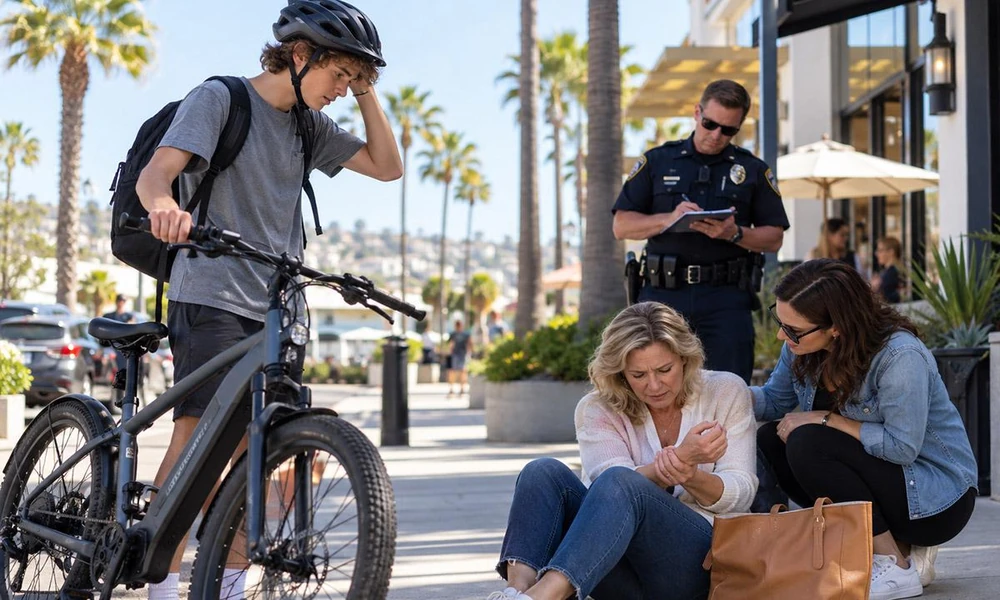
If a teenager on an e-bike hits you in Orange County, you may have a claim against the rider and, in some cases, against the parents. California caps a parent’s liability for a child’s willful misconduct, but parents can face broader liability for their carelessness, like buying an illegal e-moto. Insurance is often the hardest part, since many homeowner’s policies exclude motorized vehicles. Document the device, get medical care, and file within two years.
You were walking out of a coffee shop in Newport Beach or crossing near a school in Irvine when a teenager on an e-bike came flying down the sidewalk. Now you have a broken wrist, a pile of medical bills, and a question nobody seems able to answer: who pays? Understanding e-bike accident liability in Orange County is not simple, because the person who hurt you is a minor, and the vehicle may not even be a legal e-bike.
You are not alone. E-bike injuries have climbed sharply across the county, and many of the riders are kids and teens. Families on both sides are confused. Injured people do not know what to do, and parents worry about what they might have to pay.
This guide explains who can be held responsible, when parents are on the hook, which insurance may pay, and what to do right now to protect your claim. We will keep it in plain English.
Who Is Liable When a Teen on an E-Bike Causes a Crash?
The teen rider can be held responsible for careless riding, even as a minor. Parents may also be liable for a child’s willful misconduct, up to a cap, or for their own negligence. In some cases, a driver, property owner, or city shares the blame.
Many people assume a child cannot be sued. That is not true in California. Minors can be held responsible for their own negligence, though their age and experience are considered when deciding what was reasonable.
In practice, a teen rarely has money or insurance of their own. That is why the real questions in these cases are about the parents and about insurance. Who actually pays often matters as much as who was at fault.
Fault can also be shared. Under California’s comparative fault rules, each person’s share of blame is weighed. If a driver cut off the teen and the teen swerved into you, both may share responsibility. If a broken sidewalk played a role, a city might be involved too.
When Parents Are Responsible for a Child’s E-Bike Accident
Parents can be liable in two main ways in California. First, a state law holds parents responsible for a child’s willful misconduct, up to a capped amount. Second, parents may also be liable for their negligence, such as when they buy a child an illegal e-motorcycle or ignore known reckless riding.
The willful misconduct rule
Under California Civil Code section 1714.1, parents with custody of a minor can be held responsible when the child’s willful misconduct injures someone. “Willful” means more than an accident. It points to intentional or reckless behavior, like deliberately riding at high speed through a crowd.
This rule has limits. For injuries, it generally covers medical and hospital expenses, and the total is capped. According to the Judicial Council of California, that cap was set at $52,700 per incident as of July 1, 2023, and it is adjusted over time for inflation.
When parents were careless themselves
The biggest exposure for many parents comes from their choices. California’s general negligence law, in Civil Code section 1714, holds everyone responsible for harm caused by their lack of ordinary care. That can include parents who:
- Buy or modify a high-powered e-motor for a child who cannot legally or safely ride it
- Let a child under 16 ride a Class 3 e-bike, which state law prohibits
- Know their child rides recklessly and do nothing to stop it
The willful misconduct cap does not limit claims based on a parent’s own negligence. That is why the details of how the teen got the device and what the parents knew are so important.
A parent who hands a child a 60 mph machine cannot call the crash an accident.
E-Bike Accident Liability in Orange County Starts With What the Teen Was Riding
The type of vehicle matters. A legal e-bike has working pedals and a motor of 750 watts or less. A more powerful device, often called an e-moto, is legally a motorcycle or moped. That can mean the rider was breaking the law just by riding it, which affects fault and insurance.
California defines three classes of e-bikes in Vehicle Code section 312.5. Class 1 and Class 2 bikes top out at 20 mph. Class 3 bikes assist up to 28 mph, and riders must be at least 16. All riders under 18 must wear a helmet on any bicycle, including e-bikes.
Many of the devices teens ride today do not fit any of those classes. In April 2026, California’s Attorney General issued an alert warning that vehicles exceeding 750 watts or the class speed limits are not e-bikes, as SoCal Cycling summarized. They are mopeds or motorcycles that require registration, a motorcycle license, and insurance.
That distinction can help your case if you were injured. A teen riding an unregistered, unlicensed e-moto on a sidewalk was likely breaking several laws. Under California’s negligence rules, breaking a safety law can create a presumption that the rider was careless.
Which Insurance Pays After an E-Bike Accident?
Insurance coverage depends on the exact policies involved. The family’s homeowner’s or renter’s policy may cover it, but many exclude motorized vehicles. An umbrella policy may help. Your own health insurance and, in some situations, your uninsured motorist coverage may also play a role.
This is where many e-bike cases get stuck. Most people expect “insurance” to pay, but legal e-bikes do not require insurance in California, and teens rarely have their own policies. Here is where coverage may come from:
- The family’s homeowner’s or renter’s policy. These often include personal liability coverage, but many policies exclude motorized vehicles. A California insurance broker explains that newer policy forms can define anything self-propelled as a motor vehicle, which may limit coverage.
- An umbrella policy. Some families carry extra liability coverage that may apply when other policies do not.
- Your own health insurance. It can cover medical treatment while your claim is pending, though it may seek repayment later.
- Your auto policy’s uninsured motorist coverage. If the device was really an e-motor that legally counts as a motor vehicle, this coverage may apply. Whether it does depends on your policy’s wording.
Do not assume there is no coverage just because an adjuster says so. Policy language is technical, and exclusions are not always as broad as insurers claim. A lawyer can request the actual policy and review it.
Orange County’s Crackdown on Teen E-Bike Riding
Orange County officials are treating dangerous teen e-bike riding as a serious problem. The District Attorney has filed criminal charges against parents, school districts have banned e-bikes for younger students, and several cities have passed stricter rules. These actions can also help injured people build civil claims.
According to Voice of OC, trauma activations for e-bike injuries at CHOC jumped from 38 in 2022 to 201 in 2025. The same report described two cases that got national attention. An Aliso Viejo mother was charged after her 14-year-old, riding an illegal e-motorcycle, struck and killed an 81-year-old veteran. A Yorba Linda father was charged after helping his 12-year-old modify an e-moto to reach 60 mph.
Schools are acting too. KTLA reported that Newport-Mesa Unified banned e-bikes for elementary and middle school students. Cities including Huntington Beach, Irvine, Garden Grove, and Fullerton have tightened local rules.
Why does this decision matter to your claim? A criminal case or citation creates an official record of what happened. A police report noting an illegal device, or charges against a parent, can be strong evidence in a civil injury case. Local rules can also help show what a reasonable rider or parent should have done.
When the county calls it a crime, the insurance company cannot call it nothing.
What to Do If a Teen on an E-Bike Hit You
Get medical care, call the police, and document the device and the rider. Get the parents’ contact information, take photos of the e-bike’s pedals, motor labels, and any modifications, and talk to a lawyer before negotiating directly with the family or their insurer.
These cases can get awkward fast, especially if the family lives in your neighborhood. Stay calm and focus on protecting yourself:
- Call 911 and request a police report, even if the injury seems minor
- Get the rider’s name and the parents’ contact information
- Photograph the device, including whether it has working pedals, its motor label, and any visible modifications
- Find witnesses and save any doorbell or business camera footage
- Get medical care right away and keep every bill and record
- Do not sign anything or accept a cash offer from the family before understanding your rights
Watch the deadline. In most cases, California gives you two years to file a personal injury lawsuit under Code of Civil Procedure section 335.1. Evidence about the device can disappear quickly, especially if the family gets rid of an illegal e-moto after the crash.
If your injuries include a head injury, take it seriously. Older adults and children are especially vulnerable to concussions and traumatic brain injuries in these crashes. Our brain injury attorneys can help you understand the long-term picture.
The Bottom Line
If a teenager hits you, you don’t have to absorb the cost yourself. The rider, the parents, and the right insurance policy may all be part of the answer. The key is to document the device and the facts early, before evidence disappears.
Whether the crash happened near a school in Irvine, along the boardwalk in Newport Beach, or on a busy street in Costa Mesa, our personal injury team knows how these cases work in Orange County.
Been in an accident or hurt on the job? You don’t have to navigate insurance companies alone. Oracle Law Firm fights to get you the compensation, control, and clarity you deserve.
Get a Free Consultation or call 888.597.4099.
Disclaimer: This article is for general information only and is not legal advice. Reading it does not create an attorney-client relationship. Every case depends on its own facts, and past results do not guarantee future outcomes. For advice about your situation, speak with a licensed California attorney.
Frequently Asked Questions
Can I sue a minor who hit me on an e-bike in California?
Yes. Minors in California can be held responsible for their own negligence, though their age and experience are considered. Because teens rarely have money or insurance, these claims often focus on the parents’ liability and on any insurance policy that covers the household.
Are parents liable if their child causes an e-bike accident?
They can be. Under Civil Code section 1714.1, parents may be responsible for a child’s willful misconduct, up to a capped amount that was $52,700 per incident as of July 2023. Parents can face broader liability for their own negligence, such as buying a child an illegal e-moto or ignoring known reckless riding.
Does homeowner’s insurance cover e-bike accidents?
Occasionally. Many homeowner’s and renter’s policies include personal liability coverage but exclude motorized vehicles, and some define any self-propelled device as a motor vehicle. Whether a specific crash is covered depends on the exact policy language, so it is worth having a lawyer review it.
What is the difference between an e-bike and an e-moto in California?
A legal e-bike has working pedals, a motor of 750 watts or less, and fits into Class 1, 2, or 3. Devices that exceed those limits are treated as mopeds or motorcycles, which require registration, a motorcycle license, and insurance. Riding one illegally can be evidence that the rider was careless.
How long do I have to file a claim after an e-bike rider hits me?
Most California personal injury lawsuits must be filed within two years of the injury. If a city sidewalk or road defect played a role, a claim against the government may need to be filed within six months. Acting early also helps preserve evidence about the device.