
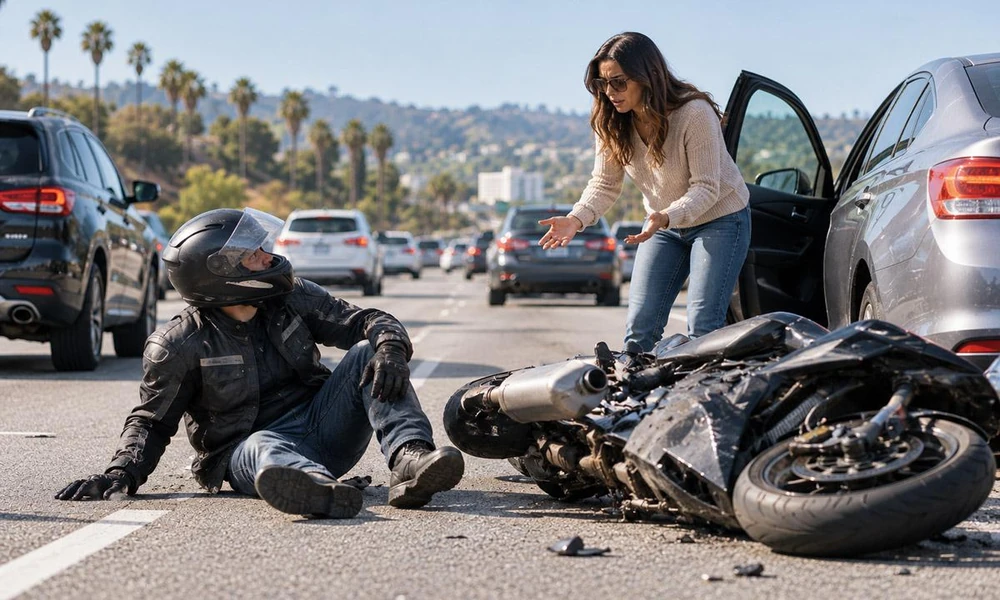
Lane splitting is legal in California under Vehicle Code section 21658.1, so riding between lanes does not by itself make you at fault for a crash. Fault depends on what each person actually did, such as an unsignaled lane change, a door flung open, or unsafe speed. Even if you share some blame, you can still recover. Talk to a motorcycle accident lawyer in Orange County before the insurer pins the whole crash on lane splitting.
Introduction
Traffic on the 405 is crawling through Irvine at 5 p.m., and you do what California riders do every day: you split the lanes. Then a car swings left without a signal, and the next thing you know you’re on the asphalt. Within a day, the driver’s insurer has its story ready. You were lane splitting, so it’s your fault.
That story is wrong more often than not. A motorcycle accident lawyer in Orange County hears it constantly, because blaming the rider is the easiest way for an insurer to shrink a claim. California is the only state that expressly recognizes lane splitting in its Vehicle Code, and doing it is not the same as being at fault.
Is Lane Splitting Legal in California?
Yes. Since January 1, 2017, California law has defined lane splitting as riding a two-wheeled motorcycle between rows of stopped or moving vehicles in the same lane. No statute sets a speed limit for it. The California Highway Patrol has published safety tips, but those tips are guidance, not law.
The definition comes from Vehicle Code section 21658.1, added by Assembly Bill 51. The law also authorized the CHP to develop educational guidelines with input from the DMV, Caltrans, the Office of Traffic Safety and rider safety groups.
The CHP’s lane splitting tips ask riders to consider the whole environment, including lane width, the size of nearby vehicles, weather and lighting. They warn that danger rises as overall speed and the speed difference between the rider and traffic increase. They also advise against splitting next to big rigs, buses and motorhomes, and they point out that riding on the shoulder is illegal and is not lane splitting.
You may hear an adjuster say you were going more than 10 mph faster than traffic, or that traffic was moving over 30 mph. Those numbers came from older CHP guidelines that were later withdrawn. The current tips contain no numeric limits. Riders can still be cited for unsafe speed or reckless riding, but there is no magic number that makes a rider automatically at fault.
Who Is at Fault in a Lane-Splitting Accident?
Fault goes to whoever acted carelessly, not to whoever was on the motorcycle. In many lane-splitting crashes, a driver changes lanes without signaling or checking mirrors, drifts within the lane, or opens a door into traffic. A rider can share fault too, for example, by splitting at a speed that left no time to react.
Several Vehicle Code rules commonly apply to drivers in these crashes. Section 22107 requires a driver to make a lane change only with reasonable safety and with a signal. Section 22517 prohibits opening a car door on the traffic side unless it’s reasonably safe. The CHP’s tips also remind drivers that intentionally blocking or impeding a motorcyclist is illegal.
California uses pure comparative fault, a rule set by the state Supreme Court in Li v. Yellow Cab Co. If a jury finds you 25% responsible because you were splitting a bit fast, you still recover 75% of your damages. The question is never just whether you were lane splitting. It’s whether the way you rode and the way the driver drove caused the crash.
Lane splitting is legal in California. Being on a motorcycle is not proof you caused the crash.
How Insurers Use Lane Splitting Against Riders
Insurers know that many drivers, and some jurors, dislike lane splitting. So they lead with it. If the police report lists lane splitting as a factor, the adjuster treats it as a confession, even though officers sometimes note it by reflex without analyzing who actually caused the collision.
Expect a few familiar moves:
- The outdated speed rule. Citing the withdrawn 10 mph and 30 mph figures as if they were law.
- The recorded statement. Asking how fast you were going and how quickly traffic was moving, then using your best guess as an admission.
- The helmet defense. Arguing that your injuries would have been less serious with a helmet or with a different helmet.
- The early offer. A quick check before anyone knows whether your shoulder needs surgery.
The helmet defense deserves a closer look. California’s Vehicle Code section 27803 requires every rider and passenger to wear a DOT-compliant helmet. Not wearing one does not cause a crash, so it doesn’t make you at fault for the collision itself. At most, the defense may try to reduce damages for specific injuries, and it generally needs evidence, often from experts, showing a helmet would have prevented or lessened those injuries.
Evidence That Wins Lane-Splitting Cases
Lane-splitting cases often hinge on a few seconds of movement, so physical and digital evidence is more important than opinions. The goal is to show where the car was, where you were, and who moved into whose path.
Here’s what to gather or preserve after a crash:
- Helmet cam and dashcam footage. Save the files right away and back them up. Ask nearby drivers whether their dashcams caught anything.
- Photos of the vehicles. Damage patterns can show whether a car moved into you or you struck a car that was holding its lane.
- The scene. Photograph lane markings, traffic conditions and where the bike came to rest.
- Witnesses. Other riders and drivers who saw the lane change are often the strongest evidence you’ll have.
- Your gear. Keep your helmet, jacket and boots. Scuffs and impact marks help reconstruct the crash.
- Medical records. Get checked right away, even if you walked away. Road rash hides fractures and concussions surprisingly often.
In serious cases, your lawyer may also look at the car’s event data recorder, phone records if distraction is suspected, and traffic speed data for that stretch of freeway at that time.
Orange County Roads Where Lane-Splitting Crashes Happen
Orange County’s freeways are built for lane splitting and for lane-splitting crashes. The 405 through Irvine, Costa Mesa and Huntington Beach jams up twice a day, and its express lane entrances create sudden merges. The 5 through Santa Ana and the El Toro Y, the 55, and the 91 toward Corona all see the stop-and-go traffic where riders split and drivers make impatient lane changes.
That traffic also means many crashes happen on freeways, where the California Highway Patrol takes the report. City police usually handle surface streets like Beach Boulevard or Harbor Boulevard. Ask for the report number before you leave the scene.
If your case ends up in court, Orange County injury lawsuits are typically handled by the Orange County Superior Court, with unlimited civil cases generally heard at the Central Justice Center in Santa Ana. Most injury suits must be filed within two years of the crash.
Insurance limits are another local reality. California’s minimum liability coverage is just $30,000 per person for injuries, and motorcycle injuries often cost far more. Check your own uninsured and underinsured motorist coverage early.
How a Motorcycle Accident Lawyer in Orange County Helps
A motorcycle accident lawyer in Orange County directly addresses the lane-splitting argument. That means preserving the evidence that shows how the crash really happened, correcting the outdated rules insurers cite, and valuing your injuries fully instead of letting an anti-rider bias set the number.
Your lawyer handles insurer calls, gathers the police report, footage and medical records, and works with reconstruction experts when the facts are disputed. They also seek every source of coverage, from the driver’s policy to your own UIM benefits.
No lawyer can promise a result, but riders who walk in with evidence and a clear legal argument are in a very different position from riders trying to explain lane splitting to an adjuster who has already decided.
Read more about our motorcycle accident practice and our broader personal injury work, or visit our Orange County personal injury lawyer page.
Riding Forward After a Lane-Splitting Crash
The key takeaway is simple. Lane splitting is legal in California, and fault turns on what each person did, not on the type of vehicle you ride. The second takeaway: evidence from the first few days, especially footage and witness names, often decides whether the insurer’s story or yours wins.
Oracle Law Firm represents injured riders across Orange County, from the beach cities to the canyons.
Been in an accident or hurt on the job? You don’t have to navigate insurance companies alone. Oracle Law Firm fights to get you the compensation, control, and clarity you deserve.
Get a Free Consultation or call 888.597.4099.
Disclaimer: This article is for general information only and is not legal advice. Reading this article does not create an attorney-client relationship. Every case depends on its own facts, and past results do not guarantee future outcomes.
Frequently Asked Questions
Is lane splitting legal in Orange County?
Yes. Lane splitting is legal throughout California, including Orange County, under Vehicle Code section 21658.1. Riders must still ride safely, and the CHP has published safety tips, but there is no statute that sets a specific speed limit for lane splitting.
Can I recover compensation if I was lane splitting when I crashed?
Yes, in many cases. Lane splitting does not automatically make you at fault. Under California’s pure comparative fault rule, you can recover even if you share some blame, with your compensation reduced by your percentage of fault.
Does not wearing a helmet hurt my motorcycle accident claim?
It can affect damages but not fault for the crash. California requires riders to wear DOT-compliant helmets, and a defendant may argue a helmet would have reduced certain injuries. That argument generally needs evidence and does not change who caused the collision.
What speed is legal for lane splitting in California?
No law sets a specific lane-splitting speed. Older CHP guidelines suggested limits, but they were withdrawn. Current CHP tips warn that danger increases with higher speeds and larger speed differences, and riders can still be cited for unsafe speed.
How long do I have to file a motorcycle accident lawsuit in California?
Most motorcycle injury lawsuits must be filed within two years of the crash under Code of Civil Procedure section 335.1. If a government agency may share fault, such as for a dangerous road condition, a claim generally must be filed within six months.